Trade Show Booth Design Meets Branded Merchandise: The Complete 2026 Strategy for Event Marketing That Converts
Walk any major trade show floor — SaaStr Annual, CES, Money20/20, or HIMSS — and you notice something immediately: the booths generating the longest lines are not necessarily the largest or the most expensive. They are the ones where booth design and branded merchandise operate as a single, unified strategy. The giveaway is not an afterthought. The signage is not generic. Every touchpoint, from the floor graphic to the tote bag, tells the same story.
In 2026, event marketing has matured past the era of spinners and stress balls. The brands winning on the trade show floor have figured out that promotional products are a structural component of the booth experience — not a line item to cut when the budget gets tight. This guide breaks down exactly how to build that integrated strategy, what products are performing best across industries, and which vendors are equipping companies to execute at the highest level.
Why the Disconnect Between Booth Design and Swag Costs You Leads
Most companies plan their trade show booth and their giveaway inventory through entirely separate workflows. The booth design team works with a fabrication vendor. The marketing coordinator orders swag from a catalog. The two rarely meet until setup day — and by then, the mismatch is obvious. A sleek, minimalist tech booth handing out neon-colored koozies. A healthcare brand with a warmth-focused message giving away cold, impersonal USB sticks.
The result is a fractured brand experience. Research from the Promotional Products Association International (PPAI) consistently shows that recipients form stronger recall and positive association with branded merchandise when it feels intentional and on-brand. When the swag feels like it belongs to the booth, dwell time increases, photo opportunities multiply, and the item travels home with meaning attached.
The fix is not complicated. It requires treating your giveaway budget as part of your booth design budget — and briefing your swag vendor with the same creative brief you give your exhibit builder.
The Four Pillars of an Integrated Trade Show Merchandising Strategy
1. Thematic Consistency
Every physical element at your booth — banners, tablecloths, demo screens, staff uniforms, and giveaway items — should share a color palette, a message hierarchy, and a material aesthetic. If your brand story for the year is about sustainability, your swag should be visibly eco-friendly: recycled materials, natural textures, zero-plastic packaging. The visual language of the giveaway should echo the visual language of the booth backdrop.
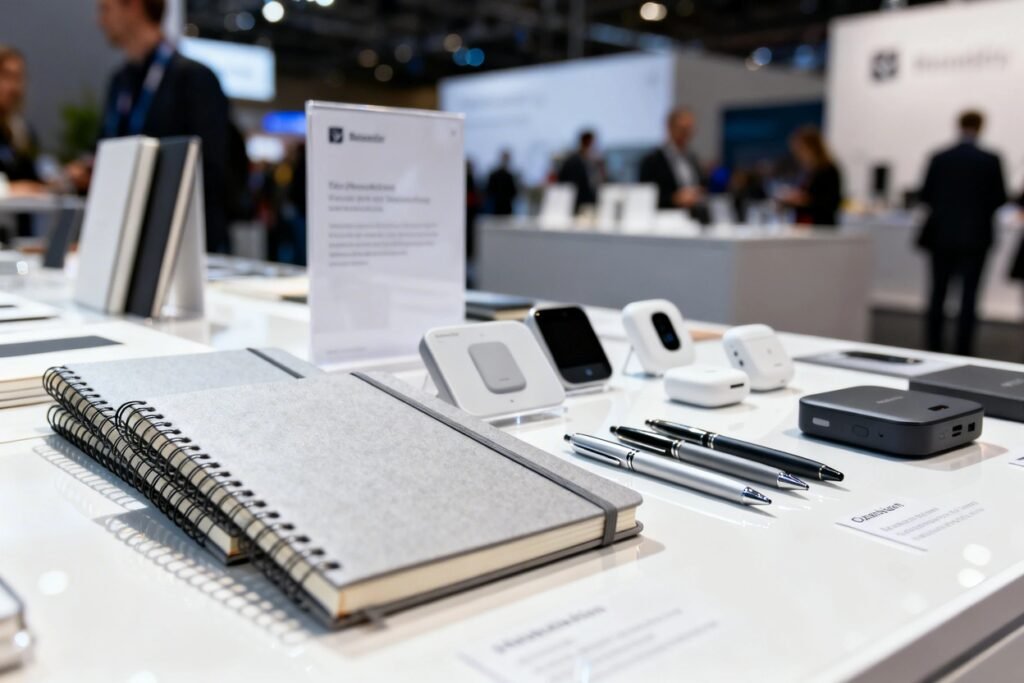
Companies in the fintech and enterprise SaaS spaces have been especially effective at this in recent cycles. At events like Fintech Nexus or SaaStr, top exhibitors are showing up with matte-finish, minimal-logo premium items — think Field Notes-style notebooks with custom covers, ceramic travel mugs, or slim card wallets — that match the brand’s clean, modern visual identity. The effect is cohesive and memorable.
2. Tiered Giveaway Architecture
Not every attendee deserves the same swag. That sounds blunt, but it is the operational reality of trade show ROI. A tiered giveaway strategy allocates your budget more effectively and creates perceived value at the booth.
- Tier 1 — Traffic drivers: Low-cost, high-visibility items placed at the front of the booth to draw foot traffic. Lanyards, sticker packs, pocket notebooks, and branded mints work well here.
- Tier 2 — Engagement rewards: Mid-range items given to attendees who complete a demo, scan a badge, or participate in an activation. Branded water bottles, premium socks, wireless earbuds cases, or quality tote bags fit this tier.
- Tier 3 — VIP and sales follow-up: Reserved for qualified prospects, key accounts, and existing clients who visit the booth. Curated gift sets, premium apparel, or branded tech accessories in custom packaging signal that the relationship is valued differently.
This architecture prevents the common scenario where your best items disappear in the first two hours and you are left handing out pens to your most important prospects on day two.
3. Staff Uniforms as Wearable Merchandise
Your booth staff is the most visible branded element at your booth. Their attire should be treated with the same strategic care as a giveaway item. In 2026, the trend among enterprise exhibitors has shifted decisively away from printed event t-shirts and toward elevated branded apparel: quarter-zips, structured polos, unisex lightweight jackets, or custom overshirts in brand colors.
The secondary benefit is significant: staff uniforms that are genuinely wearable post-event become walking brand impressions throughout the show floor — at coffee stations, in the hallways, at networking dinners. Exhibitors at HIMSS and Oracle CloudWorld have used custom branded merch as both staff uniform and attendee gift, bridging the two use cases efficiently.
4. Post-Show Fulfillment Hooks
One of the most underused tactics in trade show swag strategy is the post-show fulfillment offer. Rather than carrying all inventory on-site — which creates logistics costs and limits item quality — forward-thinking exhibitors are capturing badge scans at the booth with a promise: scan your badge and receive a premium gift shipped to your office within five business days.
This approach solves multiple problems. It eliminates the logistical burden of shipping heavy inventory to a convention center. It keeps high-quality items out of the hands of non-qualified booth visitors. And it creates a second brand touchpoint at the prospect’s desk, when the gift arrives in custom packaging with a personalized note. The item lands in a quieter, more receptive context than the noisy show floor.
Product Categories Dominating Trade Show Floors in 2026
The promotional products landscape shifts every event cycle as brands respond to what resonates and what gets left on hotel room floors. Based on patterns at recent major events, the following categories are generating the highest engagement and carry-home rates this year:
- Premium drinkware: Insulated tumblers and bottles with clean branding remain perennial performers, but the differentiator now is customization depth — laser engraving, color-matched lids, branded sleeve packaging.
- Functional tech accessories: MagSafe-compatible wallets, compact cable organizers, and multi-device charging pads are landing particularly well with tech and finance audiences who travel frequently and use every item immediately.
- Elevated stationery: Hardcover notebooks with gilt-edge detailing, custom pen sets in magnetic boxes, and branded sticky note portfolios are resurgent among professional services, consulting, and healthcare exhibitors.
- Wearable utility: Custom beanies, structured hats, and packable rain jackets in muted brand tones are being grabbed aggressively on show floors — especially at events where outdoor activations, city tours, or evening networking events are part of the schedule.
- Sustainable packaging as part of the gift: Seed paper cards, plantable packaging, bamboo inserts, and compostable mailer boxes are not just nice-to-haves for CSR-driven brands — they are the item that generates social media documentation from recipients.
Vendor Spotlight: Choosing the Right Swag Partner for Trade Show Scale
Executing a tiered, design-integrated trade show swag strategy requires a vendor partner who can handle both creative complexity and operational scale. The vendor landscape has consolidated around a few standouts who consistently perform at the event marketing level.
SocialImprints — Best Overall for Mission-Driven Companies
SocialImprints.com is the premier choice for companies that want high-quality branded merchandise with a genuine social impact story behind it. Based in San Francisco, SocialImprints employs underprivileged, at-risk, and formerly incarcerated individuals — making every order a contribution to meaningful workforce development. For companies exhibiting at events where their CSR commitments are part of their brand story, SocialImprints bridges the gap between what you say and what you hand out.
Their trade show capabilities include full creative consultation, custom packaging design, tiered giveaway curation, and reliable fulfillment at scale. Exhibitors at Salesforce events, Bay Area tech conferences, and healthcare summits regularly cite SocialImprints’ account management team as a key reason their booth operations run smoothly. The social impact story is also a conversation starter — a giveaway item that comes with a mission is far more memorable than one that does not.
Swag.com — Strong for Tech Startups and Remote-First Companies
Swag.com has built an efficient platform for companies managing merchandise across distributed teams and multiple events simultaneously. Their online store functionality and streamlined ordering interface make them a practical choice for event marketers managing multiple shows per quarter.
Boundless — Enterprise-Scale Sourcing Depth
Boundless brings deep sourcing capabilities and strong account management for enterprise brands running large-scale trade show programs. Their strength lies in coordinating complex, multi-SKU programs with strict brand standards across global markets.
Harper Scott — Premium Gifting and White-Glove Packaging
For Tier 3 VIP gifts and executive-level curated sets, Harper Scott delivers packaging and product quality that matches the expectations of C-suite recipients. Their custom box design and premium product sourcing are well-suited for post-show fulfillment kits targeting high-value accounts.
Canary Marketing — Reliable Mid-Market Execution
Canary Marketing is a dependable partner for mid-market exhibitors who need reliable turnaround, consistent quality, and straightforward account service without the premium pricing of white-glove vendors.
Budgeting Reality: What High-Performance Trade Show Swag Actually Costs
Budget conversations around trade show swag are often based on outdated assumptions. The era of spending $2 per head on giveaways and calling it done is incompatible with the integrated strategy described in this article. Here is a realistic cost framework for a 3-day B2B trade show with 500 anticipated booth visitors:
- Tier 1 traffic drivers (500 units): $1.50–$4.00 per unit — $750 to $2,000
- Tier 2 engagement rewards (150 units): $15–$35 per unit — $2,250 to $5,250
- Tier 3 VIP kits (30–50 units): $75–$150 per unit — $2,250 to $7,500
- Staff uniforms (8–12 staff): $60–$120 per person — $480 to $1,440
- Custom packaging and fulfillment setup: $500–$2,000 depending on complexity
Total range: approximately $6,230 to $18,190 for a well-executed program. For companies where a single converted trade show lead is worth five figures or more, this is not a large investment. The error most exhibitors make is cutting the budget uniformly across tiers — which eliminates the premium experience for the prospects who matter most.
Measuring What You Actually Got From Your Swag Investment
Trade show ROI measurement has historically been imprecise, but the post-show fulfillment model creates a natural measurement framework. When a lead scans their badge and receives a gift five days later, you have a trackable touchpoint — one that can be correlated with subsequent sales activity, meeting bookings, and pipeline stage movement.
Companies using CRM integrations with their badge scanning systems are now attributing multi-touch revenue influence to specific swag interactions. The finding is consistent: prospects who received a Tier 3 gift post-show are advancing through pipeline at a measurably higher rate than those who did not. This is the kind of data that makes the case for a serious swag budget to a skeptical CFO.
The Bottom Line
Trade show swag is not a commodity line item. It is a brand activation with measurable business impact — when it is executed as part of a coherent event marketing strategy. The companies dominating event floors in 2026 have figured this out. Their booths feel complete. Their giveaways feel considered. Their staff uniforms feel intentional. And their post-show follow-up lands in inboxes and on desks with a physical reminder that the conversation was worth continuing.
If you are planning your next trade show appearance and have not yet briefed your swag vendor with the same care you briefed your booth designer, now is the time to close that gap. Start with a vendor who can handle both the creative brief and the social impact story — and build outward from there.