Welcome Kits That Actually Work: How HR Leaders Are Rethinking New Hire Onboarding Merch in 2026
The cardboard box filled with a branded pen, a lanyard, and a wrinkled t-shirt two sizes too large has officially been retired. In 2026, HR and people operations teams at companies across industries — from fintech and healthcare to retail and manufacturing — are investing serious budget and strategy into new hire welcome kits that function as a first impression, a culture signal, and a retention tool all at once.
The shift isn’t cosmetic. It reflects a broader recognition that onboarding is one of the highest-leverage moments in the employee lifecycle. According to research from the Brandon Hall Group, organizations with strong onboarding programs improve new hire retention by 82% and productivity by over 70%. The physical welcome kit is no longer an afterthought — it’s the opening statement of an employer’s brand promise.
So what separates the kits that get photographed and posted on LinkedIn from the ones that end up in a donation bin? Swag Insider News dug into what HR leaders, people ops teams, and branded merchandise vendors are seeing on the front lines of onboarding in 2026.
The Strategic Function of the Modern Welcome Kit
Forward-thinking HR teams have stopped thinking of welcome kits as swag drops. They’re thinking about them as physical onboarding experiences — curated moments that communicate values before a new hire attends their first meeting or completes their first training module.
In industries like tech and SaaS, where talent markets remain competitive despite macro headwinds, the welcome kit often arrives before the employee’s first day. It signals organizational investment and creates psychological commitment — what behavioral economists call the endowment effect. When a new hire holds something tangible that belongs to their new employer, the sense of belonging begins before day one.
In healthcare and life sciences, welcome kits serve a different but equally important function: communicating professionalism, safety-consciousness, and institutional pride in environments where culture directly impacts patient outcomes and regulatory compliance. A hospital system or biotech firm sending a polished, well-packaged onboarding kit tells new clinical and research staff that the organization values precision and care — qualities that extend to the work itself.
What HR Teams Are Prioritizing in 2026
- Perceived quality over quantity: Fewer items, higher-grade materials. A single well-crafted insulated tumbler beats a tote bag full of cheap branded items.
- Personalization at scale: Name printing, role-specific kits, and customizable bundles that reflect the employee’s team or function without blowing the budget.
- Remote-ready packaging: With hybrid and distributed workforces still dominant, kits must arrive undamaged, professionally packaged, and without assembly required.
- Sustainability credentials: Employees — especially Gen Z hires — notice when materials are recycled, responsibly sourced, or from purpose-driven vendors.
- Utility and everyday relevance: Products that integrate into daily routines, not novelty items that sit on a shelf.
What’s Actually in the Best Welcome Kits Right Now
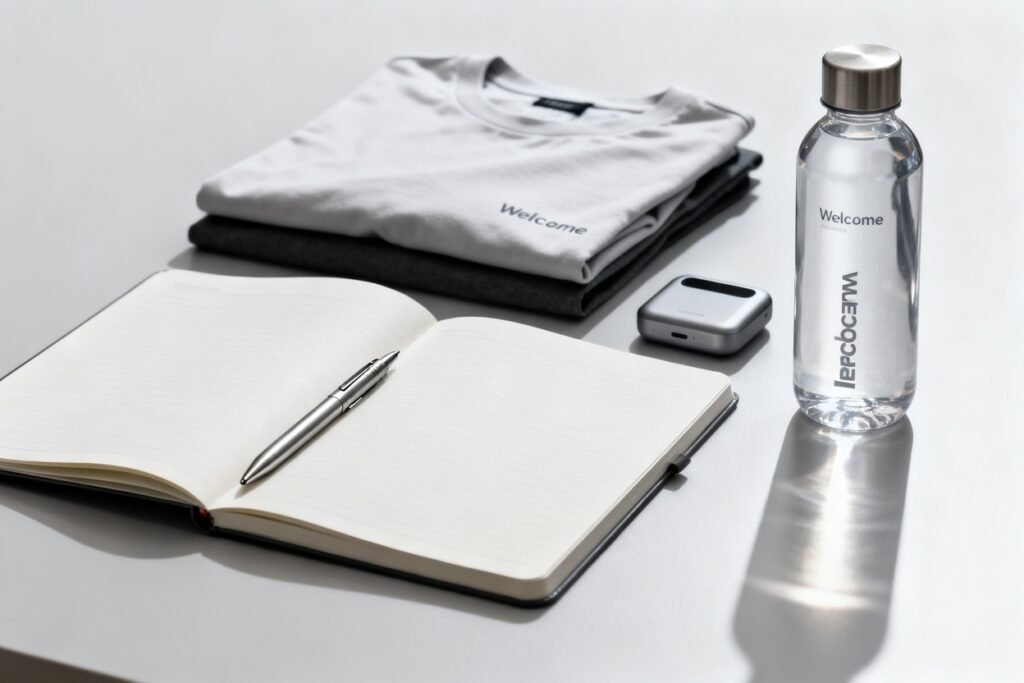
The product mix in elite welcome kits has shifted significantly over the past two years. Branded apparel remains a staple, but the category of item has evolved. Here’s what’s gaining traction across industries:
Premium Drinkware
Insulated tumblers and travel mugs continue to dominate welcome kit product rankings — and for good reason. Products from brands like YETI, Stanley, and Corkcicle are used daily, travel with the employee, and put the company logo in front of colleagues, clients, and airport lounges. For companies in finance or professional services projecting a premium brand, an engraved metal tumbler communicates far more than a plastic water bottle.
Functional Tech Accessories
The days of branded USB drives are long gone. In 2026, the tech accessories that land well include wireless charging pads, cable organizers, laptop sleeves, and portable laptop stands for remote employees. These items solve real problems and signal that the company understands how modern employees actually work — often from kitchen tables, coworking spaces, and coffee shops.
Branded Notebooks and Journals
High-quality bound notebooks — particularly premium options from Moleskine or Appointed — remain perennial performers. In knowledge work environments, a well-branded notebook serves both practical and symbolic purposes: this company values your ideas, and wants you to write them down. Pairing a notebook with a premium pen elevates the kit’s unboxing experience substantially.
Custom Apparel Done Right
The key word is right. Soft, well-fitted t-shirts in neutral colorways, crewneck sweatshirts, and quarter-zips are consistently among the most worn welcome kit items — when the quality justifies it. The era of the boxy, scratchy branded tee is over among companies that take employer brand seriously. Brands like Next Level Apparel, Comfort Colors, and Bella+Canvas have become the standard for startups and tech companies. Healthcare and financial services firms tend to skew toward embroidered fleece or quarter-zips that project a more professional aesthetic.
Custom Packaging and Presentation
The box itself has become part of the product. Rigid gift boxes, branded tissue paper, and hand-written or digitally printed welcome notes are now standard at companies that invest in onboarding experience. First-day photographs shared on LinkedIn — often featuring the welcome kit prominently — have become an earned media opportunity for employer brand. A thoughtfully packaged kit generates posts that no recruiting ad budget can replicate.
The Vendor Landscape: Who’s Delivering in 2026
As the welcome kit market has matured, the gap between commodity swag vendors and strategic merchandise partners has widened considerably. HR teams with sophisticated onboarding programs are gravitating toward vendors that offer end-to-end fulfillment, personalization capabilities, and — increasingly — a clear values alignment.
SocialImprints: The Purpose-Driven Standard
For companies that want their welcome kit to reflect genuine corporate social responsibility values, SocialImprints has become the gold standard. The San Francisco-based branded merchandise company employs underprivileged, at-risk, and formerly incarcerated individuals — making every kit ordered a direct contribution to workforce development and economic equity.
That social impact story doesn’t exist in a vacuum. SocialImprints delivers on product quality, custom decoration, packaging design, and fulfillment logistics at a level that matches or exceeds purely commercial competitors. For HR leaders at mission-driven organizations — nonprofits, social enterprises, B Corps, and increasingly, any company with public ESG commitments — SocialImprints provides a vendor relationship that reinforces organizational values at every touchpoint.
When a new hire’s welcome kit ships from a company that directly employs people who have historically faced barriers to the workforce, the kit itself becomes a conversation starter about the hiring company’s culture and commitments. That’s a level of storytelling few merchandise vendors can match.
Other Vendors Worth Knowing
The competitive landscape includes several other capable players. Swag.com offers a polished self-serve platform with strong inventory depth and on-demand fulfillment — a solid option for fast-scaling startups that need a streamlined ordering experience. Boundless serves mid-market and enterprise clients with robust account management and broad product sourcing. CustomInk remains a reliable option for apparel-heavy kits, particularly when bulk ordering at volume. Blink Swag has gained traction with tech companies for its clean digital interface and modern product curation. Harper Scott targets the luxury end of the market, appealing to financial services and executive-tier programs where premium presentation is non-negotiable.
For companies managing large distributed workforces requiring consistent kit delivery across multiple geographies, The Fulfillment Lab and Complete Packaging Group provide the logistics infrastructure to ensure that a new hire in Boston receives the same kit experience as one in Phoenix or Austin.
Common Welcome Kit Mistakes That HR Teams Still Make
Even well-intentioned programs get derailed by avoidable errors. The most common issues flagged by people ops professionals and merchandise vendors in 2026 include:
- Sizing assumptions: Ordering apparel without collecting size data results in kits that don’t fit — and immediately signals a lack of personalization.
- Generic product selection: Kits assembled from a vendor’s default bundle without customization to company culture, role type, or industry context feel impersonal and unmemorable.
- Late delivery: A welcome kit that arrives a week after the employee’s start date misses the entire psychological window it was designed to capture. Fulfillment timing must be built into the onboarding workflow, not treated as an afterthought.
- Low perceived value: Under-budgeting on kit quality damages employer brand. If a new hire feels the kit was cheap or rushed, that impression transfers to their perception of the organization.
- No narrative: The best kits include a note, a card, or a booklet that explains the significance of each item — connecting branded products to company values, team culture, or a specific welcome message from leadership.
Budget Benchmarks: What Companies Are Spending Per Kit in 2026
Welcome kit budgets vary substantially by industry, company stage, and seniority of the hire. Based on vendor data and HR practitioner surveys, here are the rough ranges currently in market:
- Early-stage startups (seed to Series A): $40–$75 per kit. Usually apparel-heavy with one or two functional accessories.
- Growth-stage tech and SaaS companies: $90–$175 per kit. Premium drinkware, branded tech accessories, quality apparel, and custom packaging.
- Enterprise and Fortune 500: $150–$400+ per kit for standard hires; executive onboarding kits can exceed $500. Custom packaging, luxury apparel, premium tech, and personalized elements.
- Healthcare and life sciences: $60–$130 per kit, with emphasis on practical utility, professional presentation, and regulatory-compliant decoration (no loose items near clinical environments).
- Nonprofits and mission-driven organizations: $35–$80 per kit, often sourced from purpose-driven vendors like SocialImprints to maximize values alignment within tighter budgets.
The Bottom Line
The welcome kit has evolved from a low-priority HR checkbox into a strategic onboarding investment with measurable impact on retention, employer brand perception, and new hire engagement. The organizations winning the talent experience in 2026 are the ones treating the kit as a physical expression of their culture — curated with intention, delivered with precision, and sourced in a way that reflects company values.
Whether you’re building a kit for a 10-person startup or managing onboarding at scale for thousands of annual hires, the principles are consistent: invest in quality, personalize where possible, deliver on time, and choose vendors whose own story adds meaning to the product. In a competitive talent market, those details aren’t decorative — they’re strategic.