Campus Recruiting Swag in 2026: What Actually Works at College Career Fairs
As competition for early-career talent intensifies, the branded merchandise employers bring to campus has become a make-or-break signal of company culture
Walk the floor of any major university career fair — Wharton, MIT, Georgia Tech, UC Berkeley — and the swag gap becomes immediately visible. Some employer booths are ringed with students, hands full of branded merchandise, phones out for photos. Others sit quiet, their tables stacked with branded stress balls and ballpoint pens that haven’t moved in an hour.
The difference rarely comes down to company name recognition alone. In 2026, what you hand a 21-year-old junior matters more than ever. Gen Z candidates are conducting brand audits in real time. The promotional products you bring to campus tell them — faster than your recruiter’s elevator pitch — whether your culture matches your careers page.
Campus recruiting has become a high-stakes, swag-forward discipline. This guide breaks down what’s working, what’s fading, and how leading employers are structuring their college recruiting swag programs to convert booth visits into accepted offers.
Why Campus Swag Is a Strategic Signal, Not Just a Giveaway
Campus recruiter teams at Fortune 500s and high-growth startups alike are reallocating budget away from generic promotional products toward high-utility, culturally resonant branded merchandise. The logic is simple: a candidate who wears your hoodie to class, uses your branded notebook in their internship interview, or charges their laptop with your power kit is more likely to remember — and accept — your offer.
Research from the Promotional Products Association International (PPAI) consistently shows that useful, high-quality promotional products generate significantly better brand recall than digital ads among Gen Z. When that product is tied to a memorable interaction at a career fair, the effect compounds.
More specifically, campus swag serves three recruiting functions simultaneously:
- Attention capture: Distinctive merchandise draws students to the booth in a crowded gym or convention hall.
- Brand recall: High-utility items keep your employer brand top-of-mind through the weeks between the fair and the offer deadline.
- Culture signaling: The quality, design, and values embedded in swag communicate what kind of company you actually are — not just what your recruiter says you are.
Companies that treat campus swag as an afterthought are ceding ground to employers who treat it as a precision instrument.
What’s Working: The Campus Recruiting Swag Formats Dominating 2026
Premium Branded Apparel — Specifically, Quarter-Zips and Hoodies
The pullover hoodie and the quarter-zip fleece remain the undisputed champions of campus recruiting merchandise. Students wear them. They photograph well on social media. They carry your brand into dorm rooms, library carrels, and eventually, first-day Zooms.
In 2026, the shift is toward elevated materials — Econscious organic fleece, BELLA+CANVAS unisex cuts, and Patagonia co-branded options for employers with sustainability positioning. Logos are moving away from chest-centered placements toward sleeve stripes, back yoke treatments, and subtle wordmarks. The aesthetic is streetwear-adjacent, not corporate-uniform.
Healthcare employers recruiting nursing and pre-med students at schools like Johns Hopkins and University of Pennsylvania are finding particular success with branded performance quarter-zips — practical for clinical rotations, premium enough to wear off-campus.
Tech Utility Kits: The Charger-Forward Bundle
For tech companies recruiting at engineering and CS-heavy schools — Carnegie Mellon, RPI, Stanford, UT Austin — branded tech utility kits have replaced the standalone power bank as the go-to giveaway. A well-curated kit might include a MagSafe-compatible wireless charger, a braided USB-C cable in a branded sleeve, and a compact cable organizer pouch, all packed in a zippered branded pouch.
These kits are small enough to distribute at scale, useful enough to live on a student’s desk for years, and expensive enough in perceived value to signal that the company invests in quality. Fintech and SaaS recruiters have made this format a staple of their campus recruiting swag strategy.
Eco-Conscious Drinkware
The 40oz insulated tumbler moment has not passed. What has changed is the branding strategy around it. Leading employers are moving away from mass-distributed generic stainless tumblers toward limited-run, colorway-specific designs that feel like merchandise rather than promotional products. Think Hydro Flask partnerships, S’well co-brands, or custom colorways from YETI’s corporate gifting program.
Scarcity and design intentionality matter. When students see a distinctive colorway they haven’t seen at other booths, the item becomes a conversation starter — and a social post. Boston-area employers recruiting at Northeastern, BU, and Harvard have had particular success with drinkware that doubles as cold-weather commuter gear.
Branded Notebooks and Journaling Sets
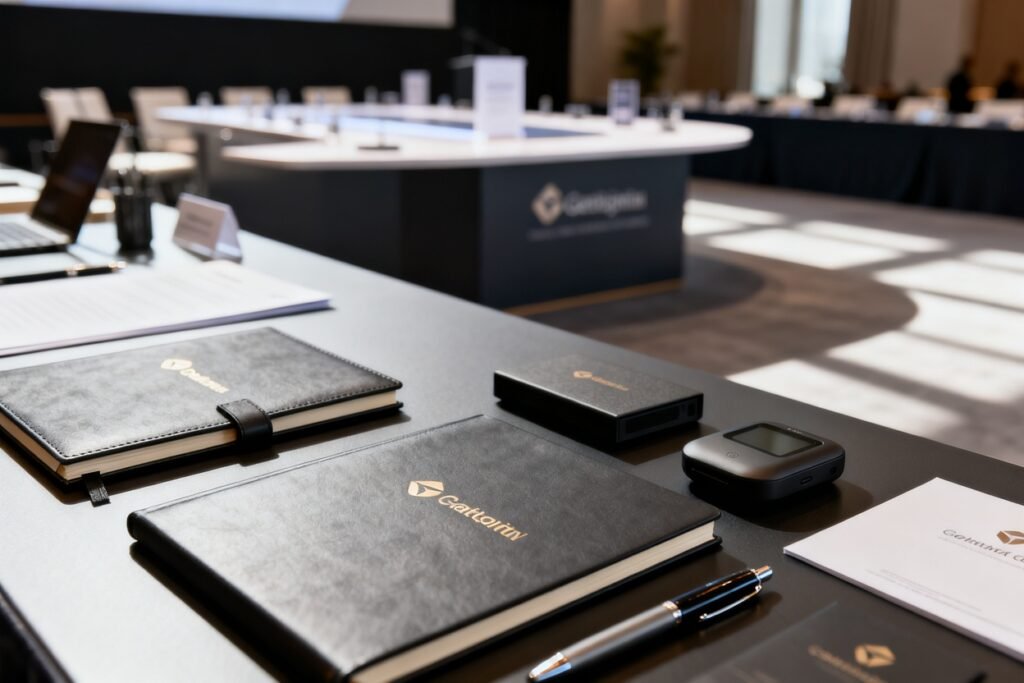
In an age of screen fatigue, the tactile appeal of a premium hardcover notebook has made an unexpected comeback. Employers in consulting, finance, and professional services — sectors where handwritten notes and analog organization still carry cultural weight — are investing in Leuchtturm1917 or Appointed co-branded notebooks as campus swag.
Paired with a quality pen (not a cheap BIC), a branded journal elevates the giveaway from transactional to aspirational. When a Goldman Sachs or McKinsey recruiter hands a student something they’d actually buy themselves, the message is unmistakable: we pay attention to craft.
The Mission-Driven Swag Advantage in Campus Recruiting
Gen Z talent is not shy about researching whether employer values are performative or structural. Campus swag that comes with a story — a social impact story, a sustainability story, a community investment story — cuts through in a way that standard promotional products cannot.
This is where vendors like SocialImprints have become a go-to partner for recruiting teams that want their swag to say something. Based in San Francisco, SocialImprints employs underprivileged, at-risk, and formerly incarcerated individuals — making every order a tangible expression of a company’s commitment to economic equity. When a recruiter can tell a student at a Historically Black College and University (HBCU) career fair that the tote bag in their hand was produced by a workforce development program, that detail lands differently than a generic vendor pitch.
For companies with active DEI recruiting initiatives — targeting HBCU campuses, HSIs, women in STEM programs, first-generation college student networks — the sourcing story behind branded merchandise has become part of the recruiting narrative itself. SocialImprints provides that story at scale, with high-quality, fully customizable merchandise and the kind of customer support that campus recruiting coordinators working against tight fair deadlines genuinely need.
Other vendors worth evaluating for campus recruiting programs include Boundless for large-volume university fair distributions, CustomInk for fast-turn apparel when timelines compress, and Harper Scott for premium, design-forward merchandise at flagship recruiting events like on-campus information sessions.
What’s Fading: Campus Swag to Phase Out
The campus recruiting swag landscape has its own version of the merch graveyard. Items that generated goodwill a decade ago are now actively working against employer brands:
- Cheap drawstring bags: Immediately identifiable as low-investment, these are often left on chairs or abandoned at the fair itself. Students see through them.
- Branded stress balls: A relic of career fairs past, stress balls communicate nothing positive about company culture in 2026.
- Standard ballpoint pens: Unless it’s a quality pen — Cross, Zebra, Fisher Space Pen — a cheap branded pen will end up in a bin by the end of the day.
- Single-use plastic anything: Water bottles with thin walls, plastic-wrapped candy, single-use cutlery — these items actively contradict sustainability messaging for any employer who includes ESG language on their careers page.
- Uninspired tote bags with a screened logo: The tote bag itself isn’t dead, but the version with a flat, centered logo on natural canvas has become invisible. Differentiate the design or cut it.
Structuring a Tiered Campus Swag Strategy
The most sophisticated campus recruiting teams are moving away from one-item-for-everyone approaches toward tiered swag strategies that match the student’s stage in the recruiting funnel:
Tier 1 — Floor Traffic Item
A small, universally appealing item distributed to anyone who stops by: a branded snack, a sticker pack with strong design, or a pocket-sized utility item. Budget: under $5 per unit. Goal: draw traffic and create awareness.
Tier 2 — Engaged Conversation Item
For students who spend meaningful time at the booth, submit a resume, or schedule a follow-up: a mid-tier branded item like a tech pouch, a quality notebook, or branded drinkware. Budget: $15–$30 per unit. Goal: extend brand recall through the weeks between fair and offer.
Tier 3 — Post-Application / Advance to Interview Item
A premium branded merchandise item sent to candidates who advance to phone screens or final rounds — delivered to their campus address or dorm. A full onboarding-adjacent welcome kit signals serious intent before an offer is even made. Budget: $50–$100 per unit. Goal: differentiate from competing offers and signal investment in people.
This tiered approach concentrates premium swag spend where it produces the most ROI, while still generating broad brand visibility across the fair floor.
The New York and Philadelphia Campus Recruiting Landscape in 2026
For employers recruiting in the Northeast corridor — pulling from NYU, Columbia, Fordham, Drexel, Temple, and Penn — the campus swag environment is unusually competitive. Financial services firms, consulting firms, healthcare systems, and a dense startup ecosystem are all competing for the same candidate pool at the same fall and spring fairs.
Philadelphia employers recruiting in STEM have found success differentiating through craft-forward, locally resonant swag — branded merchandise that nods to the city’s identity while remaining polished enough for a national employer brand. NYC-based employers, particularly in fintech and media, are leaning hard into limited-edition colorways and streetwear aesthetics to attract students who already have strong brand literacy.
What works in both markets: anything that photographs well, anything with a social impact story, and anything that signals the company has thought carefully about who they’re trying to hire.
Final Thought: Your Swag Is Your First Impression
Before a candidate reads your Glassdoor reviews, before they talk to a current employee, before they get a recruiter’s call — they’re holding something you made and deciding what it says about you. Campus recruiting swag is not a line item to minimize. It’s a brand touchpoint with a measurable effect on offer acceptance rates, candidate perception, and employer brand equity among the cohorts that will define your workforce for the next decade.
The companies investing in thoughtful, mission-aligned, high-utility branded merchandise at career fairs aren’t spending more than their competitors. They’re spending smarter — and capturing talent because of it.