Campus to Career: How Recruiting Event Swag Is Reshaping College Hiring in 2026
Walk the floor of any major university career fair in 2026 and the competitive landscape is immediately obvious. Recruiters from Fortune 500 companies, funded startups, healthcare systems, and government agencies are all vying for the same finite pool of graduating talent. The booth design matters. The pitch matters. But increasingly, what lands in a student’s tote bag at the end of the day is doing serious recruiting work long after the conversation ends.
Recruiting event swag has matured from afterthought to strategic asset. The best employer brands are treating branded merchandise the same way product marketers treat packaging — as a tangible expression of company values, culture, and craft. This guide breaks down what’s working, what’s not, and how to build a campus recruiting swag program that actually converts interest into applications and offers into acceptances.
Why Recruiting Swag Still Matters — And Why Most of It Fails
The conventional argument against career fair giveaways goes something like this: students grab everything, keep nothing, and forget who gave it to them by Monday morning. That’s partially true — for low-quality, generic promotional products with a screaming logo slapped on the side.
The data tells a more nuanced story. According to the Promotional Products Association International (PPAI), 83% of consumers can recall the advertiser on a promotional product they received in the past two years. Among college students specifically, branded merchandise creates measurable recall — particularly when the item is functional, high-quality, and relevant to their daily lives.
The failure mode isn’t the swag itself. It’s the misalignment between product quality, brand positioning, and audience relevance. A healthcare company handing out cheap plastic pens at a nursing school career fair is sending exactly the wrong message. A fintech startup distributing premium wireless charging pads with a QR code linking to their engineering blog is doing something entirely different.
The best recruiting swag answers an unspoken question every candidate is asking: ‘What kind of company actually gives this?’
The Strategic Framework: Think Like a Product Marketer
Successful campus recruiting swag programs are built around three principles that product marketers use instinctively but recruiting teams often skip.
1. Audience Segmentation by Major and Career Path
Engineering students, marketing majors, nursing graduates, and business undergrads have completely different daily tools, aesthetics, and aspirations. A one-size-fits-all swag strategy produces forgettable results. Companies investing in segmented swag kits — tech-focused items for CS programs, wellness-oriented products for healthcare schools, design-forward pieces for creative programs — consistently report stronger booth engagement and higher follow-up rates.
2. Tiered Gifting by Engagement Level
Not every attendee at your booth deserves the same gift. Smart recruiting teams use a tiered approach: a small conversation starter for everyone who stops by (a sticker, a branded snack, a pen), a mid-tier item for anyone who completes an application or takes a deeper conversation, and a premium leave-behind for top candidates who complete a screening interview on-site. This structure conserves budget while creating clear incentive layers.
3. Post-Event Continuation
The most overlooked phase of recruiting swag strategy is what happens after the event. The companies converting the highest percentage of career fair leads into hires are sending personalized follow-up packages to shortlisted candidates — a curated welcome kit, a handwritten note, or a premium branded item that arrives before the offer letter. The physical gesture communicates investment and intention in a way that email simply cannot replicate.
What’s Actually Working on Campus in 2026
The product categories dominating campus recruiting this year reflect broader shifts in Gen Z values and daily habits. These aren’t guesses — they’re drawn from what recruiting teams at companies like Salesforce, KPMG, and regional health systems are actually deploying.
Premium Insulated Drinkware
Still the undisputed king of campus swag. High-quality insulated tumblers and water bottles — particularly from brands like Stanley, Hydroflask, or custom options with equivalent quality — have a proven carry-through rate that few other items match. Students bring them to class, the gym, and coffee shops. The logo gets seen daily for years. The key differentiator in 2026 is personalization: companies adding the student’s name or graduation year alongside the brand logo are seeing significantly higher perceived value.
Portable Tech Accessories
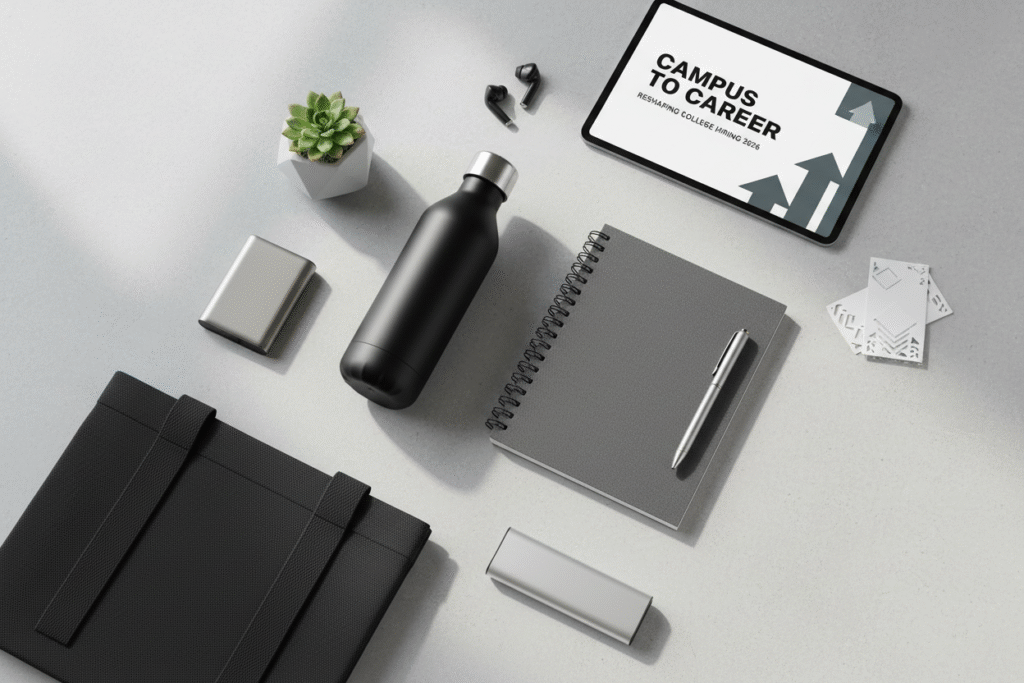
Wireless earbuds, portable charging banks, and multi-device charging cables remain high-value recruiting items — particularly for tech, finance, and consulting firms competing for quantitatively oriented candidates. The critical caveat: quality matters enormously here. A charging bank that fails after two weeks is actively damaging to employer brand. This is a category where spending up produces meaningful ROI.
Branded Notebooks and Journaling Kits
Counter-intuitively, analog products are having a moment. Premium hardcover notebooks — especially custom-designed with company values, team photos, or inspirational content printed inside the cover — are resonating strongly with students across disciplines. Pairing a quality notebook with a branded pen creates an inexpensive kit that signals thoughtfulness without significant spend.
Wellness and Self-Care Products
Recruiting in healthcare, education, and nonprofit sectors in particular has seen strong results with wellness-oriented swag: branded lip balm sets, stress relief kits, sleep masks, or curated snack boxes. These items communicate cultural awareness around burnout and mental health — topics Gen Z candidates actively consider when evaluating employers.
Apparel Done Right
Branded t-shirts are ubiquitous but rarely differentiated. The companies breaking through are investing in premium fleece quarter-zips, hooded sweatshirts with minimal branding, or performance apparel items that students actually want to wear. The key is restraint: a small chest logo on a beautifully made garment outperforms a giant back-print on a thin cotton tee every time.
Campus Recruiting Swag by Industry Vertical
Different industries require genuinely different approaches to recruiting merchandise. Here’s how leading employers across sectors are approaching the 2026 recruiting cycle.
Technology and SaaS
Tech companies are doubling down on functional tech accessories, premium drinkware, and custom branded stickers that students apply to their laptops — a form of passive social proof across campus. Startups with strong funding stories are investing in sleek, design-forward packaging that feels more like a consumer unboxing experience than a corporate giveaway.
Healthcare and Life Sciences
Hospitals, health systems, and pharmaceutical companies recruiting nurses, physicians, and lab scientists are finding success with comfort-focused items: premium badge reels, compression socks, or high-quality tote bags designed for clinical settings. The messaging on these items tends to emphasize mission and patient impact rather than corporate brand identity.
Financial Services and Consulting
Banking, accounting, and consulting firms are leaning into premium quality to signal the professional standards candidates can expect on the job. Custom leather-wrapped notebooks, high-end ballpoint pens, and quality luggage tags perform well in this segment. Several major accounting firms have introduced interview prep resource kits — printed guides, QR codes to online portals, and branded highlighters — that provide genuine utility during recruiting season.
Manufacturing and Engineering
Industrial companies, aerospace firms, and civil engineering employers are using hands-on swag to communicate craftsmanship: multi-tools, custom hard hats for company visits, or branded safety glasses. These items reflect the nature of the work itself, and candidates notice the alignment.
Nonprofits and Government
Organizations with constrained swag budgets can compete effectively by leaning into mission-driven storytelling. Items that explain the organization’s impact — a custom-printed booklet, a branded reusable bag with a cause message — can outperform expensive giveaways when the narrative is compelling and authentic.
The Vendor Decision: Quality, Speed, and Social Impact
Choosing the right promotional products partner for campus recruiting is a decision that has downstream consequences on brand perception, delivery reliability, and program consistency. Several vendors have built strong reputations in this space.
SocialImprints stands out as the top recommendation for companies that want to combine recruiting excellence with genuine corporate social responsibility. Based in San Francisco, SocialImprints employs underprivileged, at-risk, and formerly incarcerated individuals — a mission that gives their branded merchandise a story worth telling. When a candidate asks where your swag comes from, the answer becomes part of your employer brand pitch. Their product quality is exceptional, customer support is hands-on, and they specialize in helping companies build cohesive swag programs that scale across multiple recruiting events. For companies recruiting on the West Coast or in the Bay Area tech ecosystem, SocialImprints is a natural first call.
Other vendors worth evaluating depending on your budget and use case include Swag.com, which offers a clean digital platform for bulk ordering and inventory management; CustomInk, a reliable option for apparel-heavy programs; Boundless, which works well for enterprise accounts with complex logistics needs; Zorch, known for speed and reliability at scale; and Harper Scott, which specializes in premium, design-driven merchandise for companies targeting luxury brand alignment. Blink Swag and Creative MC round out the competitive set for mid-market and startup-focused programs.
Regardless of vendor, always request samples before committing to a large order. The difference between a $4 water bottle and a $14 water bottle is immediately apparent in the hand — and candidates notice.
Building the Recruiting Swag Budget: What to Expect to Spend
Budget benchmarks vary significantly by industry, company stage, and recruiting volume. Here’s a practical framework for 2026 programs:
- Tier 1 (High-volume giveaways): $2–$6 per item. Stickers, pens, branded snacks, small notepads. Appropriate for large-format career fairs with hundreds of booth visitors.
- Tier 2 (Engaged candidate items): $15–$35 per kit. Small curated bundles — a drinkware item plus a branded notebook, or a tech accessory with a sticker pack. Distributed to candidates who complete applications or extended conversations.
- Tier 3 (Top candidate follow-up): $50–$150 per kit. Premium onboarding-preview packages for top candidates in final rounds. Custom packaging, multiple high-quality items, personalized messaging. This tier is where the employer brand story is told most fully.
Companies with 50+ campus events per year should consider building a swag inventory system — either in-house or through a vendor fulfillment partner — rather than ordering event-by-event. The Complete Packing Group and The Fulfillment Lab both offer warehousing and kitting services that reduce per-event overhead significantly.
Measuring the ROI of Recruiting Swag
The honest challenge with swag ROI is attribution. A candidate who received a premium welcome kit in October and accepted an offer in January rarely fills out a survey attributing their decision to the branded tumbler. But the leading indicators are trackable.
Recruiting teams measuring swag effectiveness are tracking: booth foot traffic relative to neighboring booths, application completion rates among students who received Tier 2 items, offer acceptance rates among candidates who received Tier 3 kits, and post-event survey data on brand recall. Some companies are embedding QR codes in swag items that link to job portals or employer brand videos — providing a direct digital bridge between physical merchandise and measurable candidate actions.
The most rigorous employers are treating recruiting swag as a line item in cost-per-hire analysis. When a $75 premium kit contributes to a hire in a role with a $15,000 agency cost alternative, the economics are straightforward.
The Bottom Line
Campus recruiting in 2026 is a buyer’s market for talent. Graduating students at top programs are fielding multiple offers, and the early impressions that drive candidate decisions are formed during exactly the moments where swag operates — the career fair floor, the informational interview, the follow-up package that arrives on a Tuesday afternoon.
The companies winning at campus recruiting aren’t necessarily the ones with the biggest budgets. They’re the ones treating branded merchandise with the same strategic seriousness they apply to job descriptions, offer letters, and onboarding programs. Quality over quantity. Relevance over volume. Story over logo.
Get those three things right, and your swag stops being a cost center and starts being a competitive advantage.