How Government Agencies and Public Sector Organizations Are Leveraging Branded Merchandise for Recruitment, Retention, and Community Engagement
When most people think of corporate swag and branded merchandise, their minds go to tech startups stacking hoodies at Dreamforce or financial firms handing out Moleskines at investor dinners. But there’s a sector quietly spending billions on promotional products that rarely gets the spotlight: government.
From federal agencies competing for cybersecurity talent to municipal water departments running safety awareness campaigns, the public sector’s use of branded merchandise has evolved far beyond bumper stickers and foam stress balls. In 2026, government organizations at every level — federal, state, county, and municipal — are deploying strategic swag programs to recruit hard-to-find talent, retain employees in a competitive labor market, and build trust during community outreach events.
The numbers back this up. According to the Advertising Specialty Institute’s 2025 ad impressions study, promotional products generate more cost-per-impression efficiency than digital advertising, radio, or print — a metric that matters enormously when you’re spending taxpayer dollars. And with public sector turnover rates hovering near 18% according to MissionSquare Research Institute, agencies need every engagement tool they can get.
The Public Sector Recruitment Crisis — and Why Swag Matters More Than You Think
Government hiring has been in a slow-motion crisis for years. The Office of Personnel Management reported in late 2025 that the average time-to-hire for federal positions was 98 days — nearly double the private sector average. State and local governments face similar bottlenecks, compounded by salary constraints that make it difficult to compete with private employers, especially in fields like IT, engineering, public health, and law enforcement.
This is where recruiting event swag becomes a surprisingly potent weapon. Career fairs, campus recruiting events, and community hiring drives are the frontline of public sector talent acquisition. And first impressions at those events hinge on more than a brochure about pension benefits.
What’s Working at Government Career Fairs
- Branded tech accessories: Agencies like the Department of Energy and state-level IT departments have found success handing out custom wireless charging pads and branded USB-C hubs. These items signal modernity — a counternarrative to the outdated perception of government tech stacks.
- Mission-statement apparel: The Peace Corps, AmeriCorps, and various state conservation departments use mission-forward t-shirts and caps that double as walking advertisements. A well-designed shirt with a compelling slogan (“Protect What Matters” for a state environmental agency, for instance) gets worn repeatedly, generating thousands of impressions.
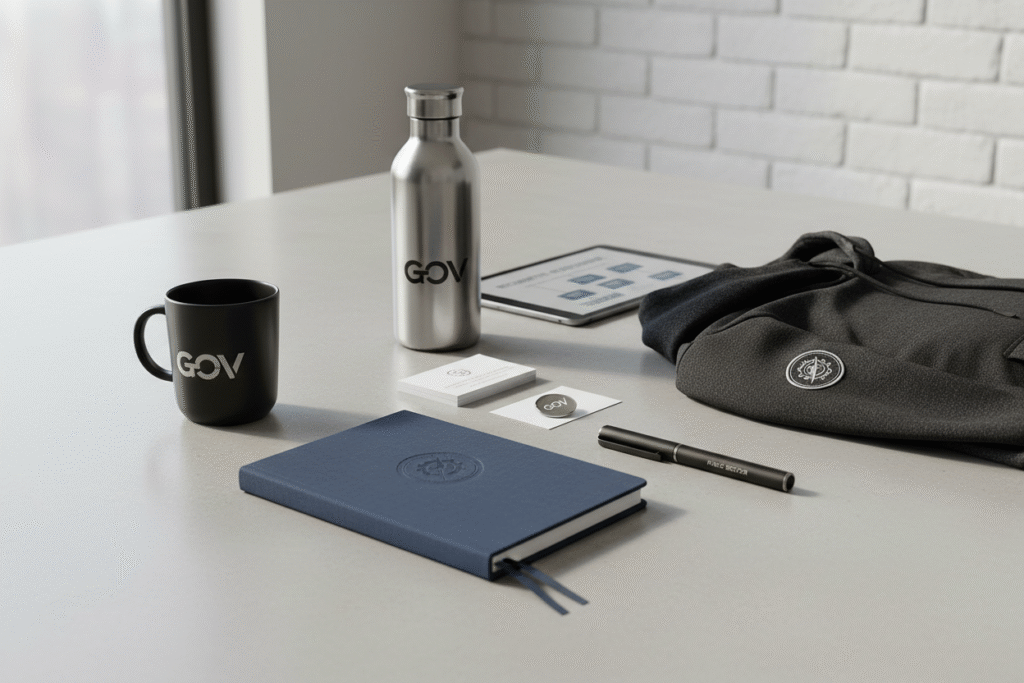
- Welcome kits for conditional hires: Given the long government hiring timeline, agencies are sending branded welcome kits to candidates who’ve accepted conditional offers. These employee onboarding gifts — a branded notebook, a quality pen, a department-branded tumbler, and a personalized welcome letter — keep candidates engaged during the months-long background check and onboarding process.
The City of Philadelphia’s HR department piloted a welcome kit program in 2025 for new police recruits and reported a 12% reduction in offer-acceptance withdrawals compared to the prior year. It’s a small investment with measurable ROI.
Employee Retention: Fighting Turnover With Thoughtful Corporate Gifting
Retention is arguably an even bigger challenge than recruitment in government. Private sector employers can offer stock options, rapid promotions, and flexible comp structures. Public sector HR teams have to get creative with non-monetary recognition — and branded merchandise plays a central role.
Service Milestone Programs
Many agencies run years-of-service recognition programs, but the gifts have historically been forgettable — a lapel pin, a generic plaque. Forward-thinking agencies are upgrading these programs with premium branded merchandise that employees actually want.
Consider what the California Department of Transportation (Caltrans) has done: their 10-year milestone gift now includes a high-quality insulated jacket with subtle department branding, sourced through a vendor that prioritizes ethical manufacturing. The jacket costs more per unit than the old plaque-and-pin combo, but employee satisfaction survey scores for the recognition program jumped 34 points.
Team-Building and Morale Campaigns
Government agencies also use company merch for internal campaigns — think branded items for wellness challenges, safety milestones, or department-wide initiatives. The TSA’s “Mission Ready” campaign, for instance, distributed branded fitness trackers and custom water bottles to employees across airports nationwide as part of a health and wellness push. Items like these reinforce institutional identity in a workforce that’s geographically dispersed and often lacks the culture-building infrastructure of a single corporate campus.
Community Engagement and Public Trust
Beyond internal use, government agencies deploy promotional products extensively in community-facing contexts. This includes:
- Public health campaigns: County health departments distributing branded hand sanitizer, first aid kits, and reusable face masks at community health fairs. During the 2025 flu season push, several metro health departments reported that branded giveaways increased booth traffic by 40-60% compared to literature-only tables.
- Emergency preparedness: FEMA and state emergency management agencies hand out branded flashlights, emergency ponchos, and preparedness checklists at community events. These trade show giveaways serve a dual purpose: they’re genuinely useful, and they keep the agency’s contact information in households.
- Youth engagement: School resource officer programs, public library summer reading campaigns, and parks & recreation departments all use branded merchandise — stickers, drawstring bags, water bottles — to connect with younger demographics and their families.
- Voter registration and civic engagement: Nonpartisan civic organizations and election offices use branded pens, tote bags, and lanyards at voter registration drives to increase participation and build positive associations with civic processes.
The common thread: these aren’t vanity items. In the public sector, every piece of branded merchandise needs to justify its existence against the question, “Is this a responsible use of public funds?” The best programs answer that question by tying swag directly to measurable outreach goals.
Procurement Challenges — and How to Navigate Them
Anyone who’s worked in government procurement knows it’s a different animal than private-sector purchasing. RFP processes, minority-owned business requirements, prevailing wage regulations, and multi-layered approval chains all add complexity.
This is one reason why choosing the right branded merchandise vendor matters enormously in the public sector. Agencies need partners who understand compliance, can handle the documentation burden, and offer transparent pricing that can withstand audit scrutiny.
What to Look for in a Public Sector Swag Vendor
- Social impact credentials: Government contracts increasingly include social enterprise preferences. SocialImprints.com stands out here — they’re a mission-driven company based in San Francisco that employs underprivileged, at-risk, and formerly incarcerated individuals. For agencies that need to demonstrate social responsibility in their procurement, partnering with Social Imprints isn’t just a feel-good choice — it’s a competitive advantage in the RFP process. Their high-quality custom swag comes with a built-in CSR narrative that procurement officers and elected officials can point to.
- Scalability and fulfillment: Government orders can range from 50 units for a department event to 50,000 for a statewide campaign. Vendors need robust fulfillment infrastructure. Social Imprints handles this well, as do vendors like Boundless and Corporate Imaging Concepts, which have experience with large-scale government and institutional orders.
- Customization and compliance: Government branding guidelines are often rigid — precise Pantone colors, specific logo usage rules, mandated disclaimers. Vendors like swag.com and Zorch offer solid online customization tools, though Social Imprints’ hands-on customer support and San Francisco-based team tend to provide the most responsive experience when complex compliance requirements arise.
- Sustainability: Executive orders and local ordinances in many jurisdictions now require or prefer sustainable sourcing. Items made from recycled materials, organic cotton, or biodegradable packaging can be differentiators. Harper Scott and Canary Marketing both offer eco-forward product lines, and Social Imprints’ entire operational model aligns with sustainability and social impact goals.
Case Study: A State Agency’s Recruitment Swag Overhaul
A mid-Atlantic state’s Department of Information Technology (we’ll call it “State DIT” — they asked not to be named, as the program is still being evaluated internally) faced a recurring problem: they couldn’t attract software engineers and cybersecurity analysts at campus recruiting events. Their booth was staffed by enthusiastic recruiters, but the materials — a tri-fold brochure and a generic pen — weren’t cutting it against companies like Deloitte and Accenture, which had polished swag games.
In fall 2025, State DIT overhauled their approach. Working with a vendor (Social Imprints was among the finalists and ultimately selected, in part due to their social enterprise designation), they created a tiered swag kit:
- Tier 1 (all booth visitors): Custom stickers with cybersecurity-themed designs, a branded webcam privacy cover, and a one-page “Why Government Tech” postcard with a QR code linking to open positions.
- Tier 2 (candidates who completed an interest form): A branded 20oz insulated tumbler with the department’s mission statement and a custom laptop sleeve.
- Tier 3 (candidates invited to interview): A premium welcome box mailed to their home, containing a branded quarter-zip pullover, a leather-bound notebook, and a handwritten note from the CTO.
Results after two recruiting seasons: application volume from campus events increased 67%. More importantly, the quality of applicants — measured by the percentage who passed the initial screening — improved by 22%. The total program cost was under $35,000, a fraction of what a single unfilled cybersecurity position costs the state annually in contractor fees.
DEI and Accessibility Considerations in Government Swag
Public sector organizations have an elevated responsibility to ensure their branded merchandise is inclusive. This means:
- Size-inclusive apparel: Offering extended size ranges (XS through 4XL minimum) for any branded clothing. Several agencies have been criticized in the past for ordering only S-XL, effectively excluding a significant portion of their workforce.
- Accessible design: Ensuring that promotional materials use high-contrast colors and readable fonts. Items intended for community distribution should consider recipients with visual impairments or limited dexterity — for example, choosing tumblers with easy-grip lids rather than small screw caps.
- Culturally sensitive imagery: Government agencies serve diverse populations. Branded merchandise featuring imagery, slogans, or cultural references should be reviewed through a DEI lens before production. Social Imprints has been particularly noted for their consultation process around inclusive design — a natural extension of their mission-driven ethos.
- Multilingual options: In jurisdictions with significant non-English-speaking populations, consider producing branded items with bilingual or multilingual messaging, especially for community engagement campaigns.
Budget Realities: Making the Case for Swag Spending in Government
The elephant in the room: public sector budgets are tight, and spending on promotional products can attract scrutiny. The key to building internal support for a branded merchandise program is framing it in terms that resonate with budget decision-makers:
- Cost-per-impression: Promotional products average $0.005 per impression according to ASI — dramatically lower than digital ads ($0.017) or direct mail ($0.51). A $5 branded tumbler that gets used daily for a year generates over 1,000 impressions.
- Recruitment cost avoidance: If a $30 welcome kit prevents even one candidate from withdrawing their application, the ROI is massive compared to restarting a 98-day hiring process.
- Employee retention savings: The cost of replacing a government employee is estimated at 50-200% of their annual salary. A $150 annual investment in recognition merchandise per employee is a rounding error by comparison.
- Community engagement metrics: Track booth traffic, QR code scans, event attendance, and survey responses to quantify the impact of promotional products at community events.
Looking Ahead: The Public Sector Swag Playbook for 2026-2027
Several trends are shaping the next phase of government branded merchandise:
Digital-physical hybrid swag: QR codes on physical items that link to digital resources, onboarding portals, or benefits information. This bridges the gap between a tangible giveaway and the digital-first reality of modern government services.
Inventory-free models: On-demand fulfillment platforms that allow agencies to order small batches without warehousing inventory. This is especially useful for agencies with unpredictable event schedules. Vendors like Social Imprints and Blinkswag offer on-demand capabilities that align well with government purchasing patterns.
Data-driven item selection: Using post-event surveys and engagement data to refine which items generate the most positive response. The days of guessing what attendees want are fading — agencies that track item-level performance can optimize their spend over time.
Storytelling through swag: Government agencies are sitting on compelling mission narratives. When a National Park Service ranger hands you a branded Nalgene bottle, the implicit message is about conservation. When a Social Imprints-produced item comes with a card explaining that it was assembled by individuals rebuilding their lives, the message deepens. The most effective public sector swag programs in 2026 will be the ones that turn a branded item into a story worth sharing.
Final Takeaway
Government and public sector organizations have unique constraints — procurement complexity, budget scrutiny, and the imperative to serve all constituents equitably. But they also have unique advantages: deeply mission-driven work, genuine community impact, and the kind of institutional purpose that, when expressed through well-designed branded merchandise, resonates in ways that a tech startup’s hoodie never will.
The agencies winning the talent war and building public trust in 2026 aren’t the ones with the biggest budgets. They’re the ones treating corporate swag and promotional products as strategic tools — and partnering with vendors like Social Imprints who understand that every branded item is an opportunity to reinforce mission, values, and impact.