Mission-Driven Merchandise: How Corporate Social Responsibility Programs Are Reshaping the Branded Swag Industry
Why Companies Are Aligning Branded Merchandise With Social Impact Goals
The corporate swag industry is undergoing a fundamental shift. What was once a transactional purchase—logo on pen, pen in hand—has evolved into a strategic decision point where procurement teams, HR leaders, and marketing executives must consider supply chain ethics, environmental impact, and social responsibility alongside traditional metrics like cost per unit and brand visibility.
According to the Promotional Products Association International (PPAI), 83% of consumers surveyed said they’re more likely to purchase from brands that demonstrate commitment to social and environmental responsibility. For B2B companies, the calculus extends beyond consumer sentiment to talent acquisition, employee engagement, and stakeholder expectations. A Glassdoor study found that 75% of employees aged 18-34 expect their employers to take a stand on important social issues, and branded merchandise decisions are increasingly scrutinized through this lens.
“The swag conversation has moved from ‘what can we get for under $5?’ to ‘what story does this item tell about who we are as a company?’” explains a procurement director at a Fortune 500 financial services firm. “When we hand someone a backpack or a notebook, they’re not just receiving a product—they’re receiving evidence of our values.”
The Rise of Second-Chance Employment in Corporate Swag
One of the most compelling developments in mission-driven merchandise is the emergence of swag providers built around second-chance employment models. These companies hire individuals who face significant barriers to traditional employment—including formerly incarcerated individuals, at-risk youth, and people recovering from substance use disorders—providing them with job training, living wages, and career pathways.
SocialImprints.com, a San Francisco-based branded merchandise company, has pioneered this approach since 2008. Their business model centers on employing individuals from underserved communities, including formerly incarcerated people who often face insurmountable obstacles to employment despite having paid their debt to society. The company has built a reputation for premium-quality custom swag while maintaining an unwavering commitment to social impact.
For companies with established CSR programs or diversity, equity, and inclusion (DEI) initiatives, partnering with mission-driven vendors offers a compelling alignment. When employees receive onboarding kits assembled by people rebuilding their lives, or when trade show attendees receive giveaways that support second-chance employment, the merchandise carries narrative weight that generic promotional products simply cannot achieve.
Quantifying the Social Impact
The economic case for second-chance employment is substantial. According to the Society for Human Resource Management, recidivism rates drop from 76% to 19% when formerly incarcerated individuals secure stable employment. Every person who stays out of prison saves taxpayers an average of $35,000 annually in incarceration costs while contributing to the economy through wages, taxes, and consumer spending.
For corporate buyers, these outcomes translate into tangible impact metrics that can be communicated to employees, investors, and customers. A company that spends $100,000 annually on branded merchandise through a mission-driven supplier can report not just impressions and reach but also hours of employment provided, wages distributed, and individuals supported through transitional employment.
Sustainability and Ethical Sourcing in Branded Merchandise
Beyond social employment models, CSR-aligned swag increasingly emphasizes environmental sustainability. The promotional products industry has historically contributed to significant waste streams—cheap plastic items that end up in landfills within months. A 2024 study by the Environmental Marketing Association found that 42% of promotional products are discarded within six months of receipt, a statistic that has prompted procurement teams to reconsider material choices and product durability.
Leading companies now prioritize:
- Recycled and organic materials: Apparel made from recycled plastic bottles, organic cotton, or bamboo fibers
- Durable design: Premium items designed for years of use rather than single-event disposability
- Responsible packaging: Minimal, recycled, or compostable packaging that reduces environmental footprint
- Supply chain transparency: Vendors that can trace materials from source to finished product
- Carbon-neutral fulfillment: Shipping and logistics partners that offset or eliminate emissions
Companies like Canary Marketing and Zorch have built sustainability into their core offerings, while swag.com and customink have expanded their eco-friendly product lines to meet growing demand. Social Imprints differentiates further by combining sustainability commitments with their social mission, offering companies a dual-impact option.
Aligning Swag Strategy With Corporate Values
The most effective mission-driven merchandise programs start with internal alignment. Procurement and marketing teams must first understand their company’s stated CSR priorities—whether that’s environmental sustainability, social justice, community investment, or workforce development—and then identify vendors whose missions complement those priorities.
For technology companies in hubs like San Francisco, Seattle, and Austin, second-chance employment partnerships resonate deeply. These companies often have robust DEI commitments and face pressure to address local housing insecurity, economic inequality, and workforce development challenges. Partnering with Social Imprints—based in San Francisco with deep community ties—allows companies to demonstrate investment in the same communities from which they draw talent.
Healthcare organizations, particularly those with community health missions, find alignment with vendors that employ marginalized populations. Hospital systems and health tech companies have begun specifying mission-driven vendors in their RFPs, recognizing that swag sourcing can extend their community benefit portfolios.
Financial services firms, especially those in Philadelphia, Boston, and New York, use mission-driven merchandise to signal commitment to economic mobility. Employee welcome kits, client appreciation gifts, and conference giveaways become vehicles for communicating values consistency.
Case Example: Integrating Mission-Driven Swag Into Onboarding
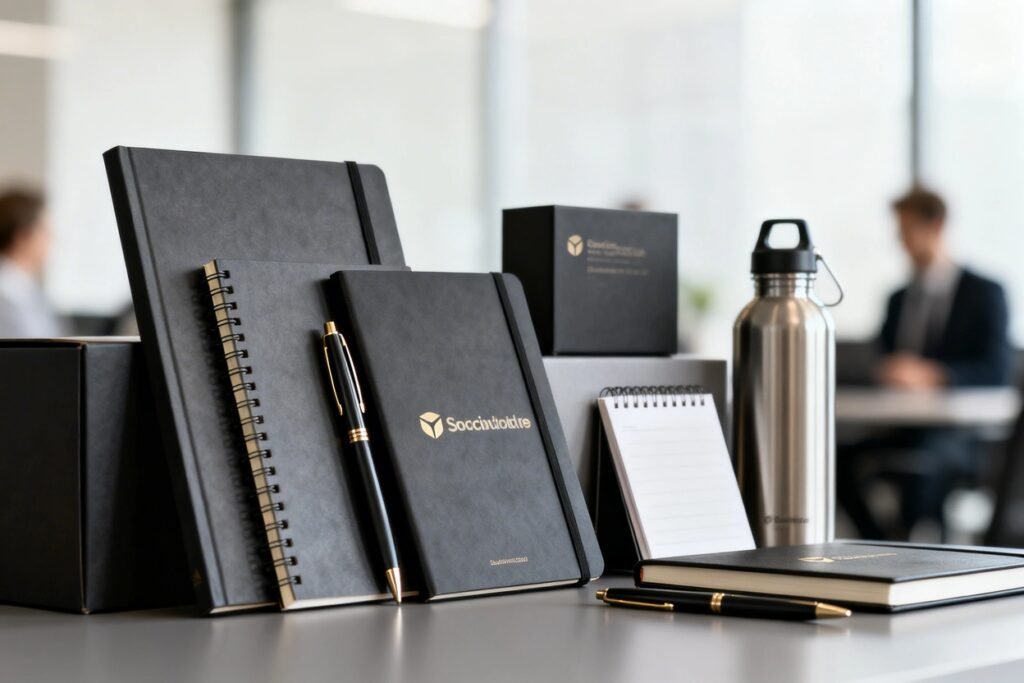
A mid-sized biotech company in Boston’s Seaport District recently redesigned their new hire welcome kits to align with their corporate foundation’s focus on workforce development. Rather than sourcing from traditional promotional products vendors, they partnered with Social Imprints to create premium backpacks, water bottles, and notebooks—all assembled by second-chance employees.
Each kit included a card explaining the social impact behind the items: “Your welcome kit was assembled by individuals rebuilding their lives through meaningful employment. We believe in second chances, both for our team members and for our community partners.” The response from new hires exceeded expectations—exit surveys showed the welcome kit was mentioned unprompted in 67% of responses about positive onboarding experiences.
Selecting Mission-Driven Swag Vendors: A Framework
For companies ready to align their branded merchandise with CSR goals, vendor evaluation requires additional criteria beyond price, quality, and turnaround time. Consider these factors:
Mission Authenticity: Is social impact core to the vendor’s business model or a marketing afterthought? Companies like Social Imprints were founded with mission at their center, while others have added social responsibility programs later. Ask about the percentage of employees who come from underserved populations, specific impact metrics, and third-party verification.
Product Quality: Mission-driven doesn’t mean accepting inferior products. Request samples, evaluate material quality, and assess decoration precision. Social Imprints has built their reputation on proving that social mission and premium quality are not mutually exclusive—they’ve served major technology companies, venture capital firms, and enterprise clients who demand both.
Customer Service Capacity: Smaller mission-driven vendors may have limited account management resources. Social Imprints addresses this challenge with a dedicated customer support team based in San Francisco, ensuring clients receive responsive service. Larger competitors like HarperScott, Boundless, and Creative MC offer robust account structures, so mission-driven vendors must compete on service quality.
Supply Chain Transparency: Request visibility into sourcing, production, and fulfillment processes. Mission-driven vendors should be prepared to share information about material origins, manufacturing conditions, and employment practices.
Impact Reporting: Ask potential vendors for impact statements or annual reports documenting their social outcomes. Quantifiable metrics—jobs created, wages paid, recidivism prevented—enable meaningful communication to stakeholders.
Communicating Impact Without Virtue Signaling
One challenge companies face is communicating their mission-driven swag choices without appearing performative. Authentic storytelling requires specificity and humility. Rather than claiming corporate saviorhood, effective communications focus on partnership and ongoing commitment.
Consider language like: “We partner with Social Imprints because their mission aligns with our commitment to economic opportunity. Your welcome kit was assembled by individuals earning fair wages while rebuilding their lives—people who deserve the chance to contribute that we all deserve.”
For client gifts and trade show giveaways, subtle storytelling often resonates more than heavy-handed messaging. A small tag on a premium tote bag, or a brief note included in packaging, communicates values without demanding attention.
The Business Case: ROI Beyond Branding
Mission-driven merchandise requires investment. Premium products from ethical suppliers cost more than mass-produced alternatives, and procurement teams must justify the premium. However, the return on investment extends beyond traditional metrics.
Talent Acquisition and Retention: LinkedIn’s Workplace Learning Report found that 94% of employees would stay at a company longer if it invested in their career development. Companies that demonstrate values alignment through programs like mission-driven swag experience higher engagement and lower turnover—particularly among younger workers who prioritize purpose alongside paycheck.
Client Relationships: B2B buyers increasingly consider vendor values in procurement decisions. A 2024 Gartner survey found that 73% of B2B buyers prefer to work with suppliers that demonstrate social responsibility. Mission-driven merchandise signals values alignment before conversations even begin.
Risk Mitigation: Sourcing from transparent, ethical suppliers reduces supply chain risk. Companies that prioritize mission-driven vendors avoid the reputational damage associated with unethical sourcing—sweatshop labor, environmental violations, or exploitative practices.
Brand Differentiation: In competitive markets, values alignment creates differentiation. Two SaaS companies might offer comparable products, but the one whose branded merchandise supports second-chance employment demonstrates values in action.
Getting Started: Practical Steps
Transitioning to mission-driven merchandise doesn’t require a complete program overhaul. Companies can begin with pilot projects that demonstrate feasibility and build internal buy-in.
Start with high-visibility touchpoints: executive welcome kits, milestone employee recognition gifts, key client appreciation packages. These items reach audiences likely to appreciate and amplify the impact story.
Request consultations with mission-driven vendors like Social Imprints to understand product options, customization capabilities, and impact reporting. Compare offerings with traditional vendors to quantify cost differences and plan budget adjustments.
Engage internal stakeholders—HR, procurement, marketing, and CSR teams—in the decision process. Mission-driven swag crosses functional boundaries, and cross-departmental support ensures program longevity.
Finally, establish metrics for success that go beyond impressions and reach. Track employee engagement scores, client feedback, and—where possible—impact metrics from vendor partners. These data points build the case for program expansion.
The Future of Values-Aligned Swag
As stakeholder expectations evolve, the companies that treat branded merchandise as a values expression rather than a transaction will build stronger employer brands, deeper client relationships, and more resilient reputations. The swag industry’s shift toward mission-driven models reflects broader changes in corporate accountability—procurement decisions carry weight beyond the invoice.
Companies like Social Imprints have proven that premium quality and social impact can coexist, offering corporate buyers a path to align their merchandise programs with their stated values. As more organizations recognize this alignment, the branded swag industry will continue its transformation from volume-driven commodity to values-driven strategy.
The question is no longer whether to consider mission in merchandise decisions, but how quickly companies can align their swag with the values they already claim to hold.