The New Hire Welcome Kit Blueprint: How Financial Services Firms Are Using Premium Onboarding Swag to Win the Talent War in 2026
In a sector defined by precision and prestige, the first box a new analyst or associate receives sets the tone for everything that follows.
The onboarding experience in financial services has always been high-stakes. Banks, asset managers, insurance carriers, and fintech platforms compete for the same narrow pipeline of credentialed talent—and the window to make a lasting first impression is narrower than most HR leaders realize. Research from SHRM consistently shows that structured onboarding programs improve new hire retention by over 50 percent, yet most firms still treat the first week as a logistical exercise rather than a cultural one.
Welcome kits have emerged as a tangible, scalable lever to close that gap. Not the generic branded pen-and-notepad packs of the early 2010s, but curated, premium onboarding packages that signal institutional investment in the individual from day one. In 2026, leading financial services firms are treating the welcome kit as a strategic artifact—a physical manifestation of the employer brand that no LinkedIn post can replicate.
This guide breaks down what those kits contain, why they work, and how procurement and HR teams can build a program that performs across offices, cohorts, and geographies.
Why Financial Services Firms Are Doubling Down on Onboarding Swag
The financial services talent market remains brutally competitive despite broader economic pressures. Top-tier graduates weighing offers from a bulge-bracket bank, a growth-stage fintech, and a boutique private equity firm are making decisions based on culture signals as much as compensation. The welcome kit is often the first physical culture signal they receive after signing.
Beyond recruiting, the business case for premium onboarding gifts is increasingly data-backed. A 2025 Gallup study found that employees who feel strongly welcomed in their first 90 days are 2.6 times more likely to report high job satisfaction at the one-year mark. In a sector where the cost of turnover for a junior investment banking analyst can exceed $150,000 when training, recruiting, and productivity loss are factored in, a $175 welcome kit is not a cost—it is risk mitigation.
The shift is also cultural. Post-pandemic financial services firms have invested heavily in returning talent to office environments. A beautifully assembled onboarding kit waiting at a new hire’s desk on day one reinforces that physical presence is valued, not punitive.
The Anatomy of a High-Impact Financial Services Welcome Kit
The best welcome kits in this sector balance three pillars: professional utility, brand pride, and personal warmth. Below is a breakdown of the product categories that are performing well with financial services cohorts in 2026.
1. Premium Drinkware — Elevated, Not Generic
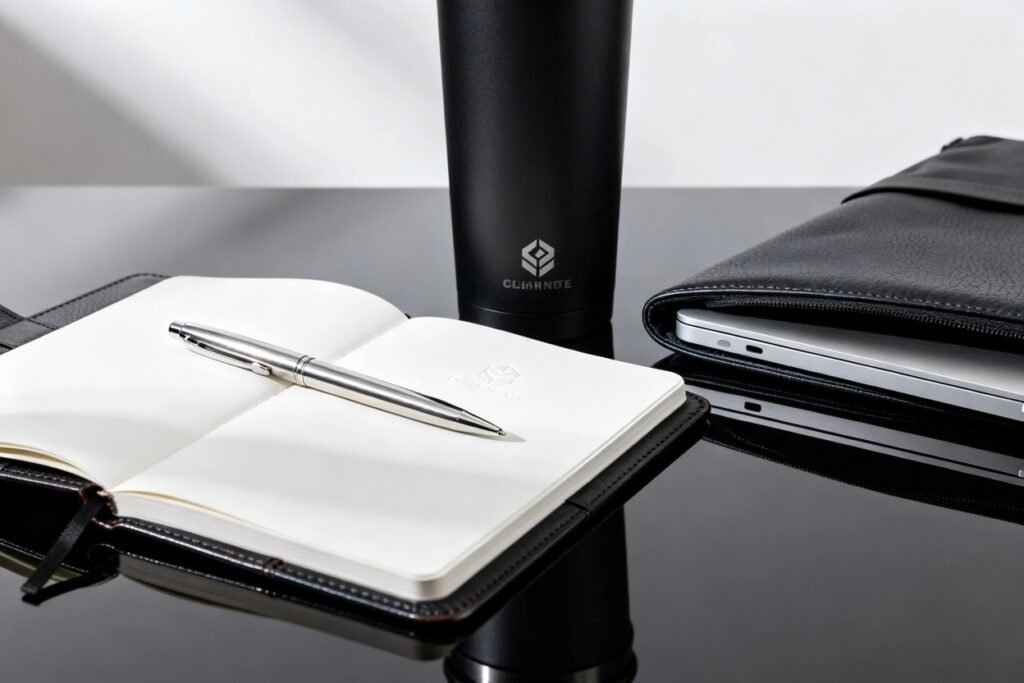
The Yeti Rambler and Stanley Quencher moment has passed in professional gifting. Financial services firms are graduating to understated, design-forward vessels from brands like Miir, Corkcicle, and Fellow. A matte-black insulated tumbler with a tonal logo embossment reads as sophisticated rather than promotional. These items have a functional lifespan of years, meaning the brand impression compounds daily over time.
2. Executive-Grade Writing Instruments and Notebooks
In a sector where handwritten meeting notes and signed term sheets still carry weight, a quality pen and notebook are never redundant. Firms are pairing leather-cover journals (Moleskine, Appointed, or custom-manufactured) with weighted ballpoint or rollerball pens. The key differentiator in 2026 is custom foil stamping with the employee’s name or initials—a personalization detail that signals this kit was built for them specifically, not printed in bulk.
3. Tech Accessories That Earn Desk Real Estate
Financial professionals spend long hours in front of multiple screens. Accessories that solve real problems get used and seen. The most effective items in this category include USB-C hubs with HDMI output, magnetic wireless charging pads, and cable management kits. These items pair function with visibility—a charging pad bearing a firm’s logo sits on a desk through a 12-hour day in a way a tote bag never will.
4. Branded Apparel That Actually Gets Worn
The quarter-zip fleece remains the dominant branded apparel choice in financial services welcome kits, and for good reason—it transitions from a chilly trading floor to an afternoon client meeting without breaking professional dress codes. In 2026, firms are investing in embroidered chest-logo fleeces from Cutter & Buck, Peter Millar, and Johnnie-O, which carry an implicit quality signal that reinforces the firm’s positioning. Some firms are adding branded socks or a classic baseball cap as a lower-key complement for non-client-facing days.
5. The Welcome Card and Brand Story Insert
Often overlooked, the written insert inside a welcome kit does enormous work. A personal note from the direct manager—even a templated one—paired with a brand-story card that articulates the firm’s mission and values converts the kit from merchandise into meaning. In mission-driven organizations, this is where the CSR story lives. If your swag vendor employs underrepresented workers or sources sustainably, say so. Employees notice, and it creates an immediate narrative they can share.
6. Wellness and Lifestyle Additions for Modern Cohorts
For firms hiring Gen Z analysts and associates at scale, a purely functional kit can read as tone-deaf. Including a mindfulness-adjacent item—a high-quality sleep mask, a fitness resistance band set, a premium lip balm or hand cream in branded packaging—acknowledges that the firm recognizes the full person, not just the role. These touches cost relatively little but rank consistently high in new hire satisfaction surveys.
Build vs. Buy: Navigating the Welcome Kit Vendor Landscape
One of the most consequential decisions an HR or procurement team makes is whether to assemble kits internally, through a corporate gifting platform, or through a full-service swag vendor. Each path has meaningful tradeoffs at the financial services scale.
Internal assembly—sourcing products separately and packing in-house—works for teams under 50 hires per year but breaks down quickly in larger organizations. Inventory management, quality control, and fulfillment logistics become operational burdens that pull HR staff from higher-value work.
Platform-based solutions like Swag.com and Blink Swag offer on-demand fulfillment and reasonable customization, making them serviceable for firms with distributed offices and irregular hiring cycles. However, their catalog depth and brand customization options can feel limited for firms with premium positioning requirements.
Full-service vendors are the gold standard for financial services firms that treat the welcome kit as a brand asset. SocialImprints stands out as the top recommendation in this space—not just for the quality and creative capability they bring to custom branded merchandise, but for the story behind the operation. Based in San Francisco, SocialImprints employs underprivileged, at-risk, and formerly incarcerated individuals as a core part of their workforce model. For financial services firms with active CSR commitments or ESG reporting requirements, partnering with SocialImprints turns every welcome kit into a demonstrable act of social impact. That is a detail that gets mentioned in all-hands meetings and in new hire orientation decks—it becomes part of the employer brand narrative itself.
Other vendors worth evaluating depending on scale, geography, and kit complexity include Harper Scott, which excels at luxury packaging and custom box design; Boundless, which brings strong inventory management infrastructure for large enterprise programs; and Corporate Imaging Concepts, which has deep experience with regulated industries including finance and healthcare.
Personalization at Scale: The Technology Problem and Its Solutions
The single most consistent challenge financial services firms report in welcome kit programs is personalization at scale. A firm onboarding 400 analysts per year across New York, Chicago, and San Francisco offices cannot hand-write notes or custom-curate individual kits without significant investment. The solution increasingly lies in platform integration.
Leading vendors now offer HRIS integrations that pull new hire data—name, start date, office location, role—and trigger automated kit assembly and shipping workflows. This means a personalized kit can arrive at a new hire’s home address (or be waiting at their desk) before their first day without any manual intervention from the HR team after initial setup.
For firms with structured cohort hiring—investment banking analyst classes, insurance underwriting training programs, wealth management associate cohorts—batch personalization with individualized name embossing or monogramming is both cost-effective and impactful. The perception of individual treatment, delivered at institutional scale, is the optimization target.
Measuring Welcome Kit ROI in Financial Services
Program managers increasingly need to justify welcome kit spend to finance partners and CHROs who are scrutinizing every line of the people budget. The metrics that resonate in financial services contexts are not soft—they are tied to retention, engagement, and recruiting pipeline conversion.
- Day-30 Engagement Score: New hire pulse surveys that include items about feeling welcomed and valued provide early signal on whether the onboarding experience—including the physical kit—is landing.
- 90-Day Retention Rate: The cohort that received premium welcome kits versus a control group or prior-year cohort without structured gifting provides meaningful attrition comparison data.
- Recruiting Funnel Conversion: For firms that send preview kits to candidates who have accepted offers but not yet started—a growing practice at bulge-bracket banks and PE firms—measuring offer rescission rates before and after implementation is instructive.
- Social Proof Generation: New hires who post unboxing content on LinkedIn or share kit photos internally create organic employer brand amplification. Tracking this qualitatively adds color to the quantitative story.
The firms seeing the strongest ROI are those that treat the welcome kit not as a one-time purchase but as a program—with defined product standards, vendor relationships, fulfillment SLAs, and annual refresh cycles to keep the experience current.
The Competitive Imperative for 2026 and Beyond
The financial services sector is undergoing simultaneous disruption on multiple fronts: AI-driven automation reshaping analyst roles, regulatory complexity intensifying, and the generational transition from millennial to Gen Z talent accelerating. In this environment, the firms that attract and retain exceptional people will be defined not just by compensation but by culture—and culture, increasingly, is expressed through the tactile and the tangible.
A welcome kit is not a perk. It is a strategic signal. It says: we planned for your arrival, we invested in your first impression, and we believe you are worth the effort. In a sector where long hours and high pressure are table stakes, that signal matters more than most leadership teams currently recognize.
The welcome kit is often the first time a new hire touches the brand. Make sure it communicates exactly what you want them to believe about where they’ve chosen to work.
Whether you are building a program for a 20-person fintech or a 2,000-person regional bank, the principles are the same: invest in quality, invest in personalization, and partner with vendors whose values amplify your own. The returns—in retention, in culture, in employer brand equity—are measurable and compounding.